Lightning in a Bottle
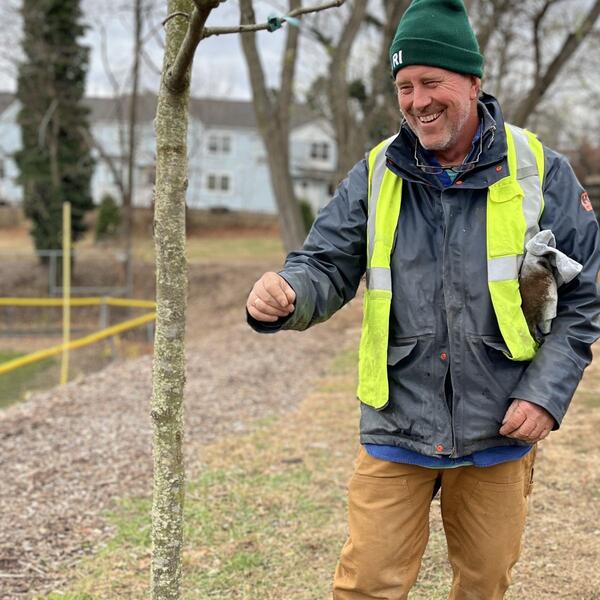
“You’ve Got Lightning in a Bottle”
Learning from Chris Ozyck’s Twenty-Five Years at URI
By Erika Svendsen, November 21, 2025
At the YSE staff meetings, colleagues are recognized for work anniversaries and special occasions. Recently, Chris Ozyck’s name flashed on the screen: twenty-five years with the Urban Resources Initiative (URI). URI Manager, Anna Pickett, watched the moment pass—an acknowledgment, then on to the next slide. Twenty-five years, she thought. People should know what that means. Chris’s official bio tells you he’s the Associate Director for URI, that he graduated from the University of Connecticut in 1989 with a degree in Landscape Design, that he’s led numerous greening initiatives and co-founded the Elm City Parks Conservancy. But those are just facts on paper. They don’t tell you who Chris really is or what his work has meant to New Haven.
So, I sat down with Chris to reflect on his career. I’ve known him nearly my entire professional life, and yet I learned his origin story for the first time. It left me wanting to get out into my own community, with strangers and friends alike, and do something.
Chris is known as a “tough read”—quiet, not one for warm and fuzzy displays. Yet he is also irreplaceable to the community work done by URI. While universities around the country seek to connect and build trust with their immediate neighbors, we have a living, breathing example of someone who has been doing exactly that for a quarter century, right here in our midst.
Chris isn’t one for conference lecterns—instead, you’ll find him in community meetings or on the front steps of a neighbor’s porch. Chris has done the steady, patient, and present work of showing up for communities, walking alongside people in their grief and their joy.
BORN IN ROUGH TERRAIN
Chris Ozyck was born in Georgia and raised in the rough terrain of North Dakota, referring to his early years as living with “nature deficit.” His father, a Vietnam War veteran, was tough like the land itself, someone Chris describes as challenging to be around. Both parents struggled with alcohol addiction. Chris is the eldest in his family, conditioned from a very early age, for better or worse, to be a caregiver.
The family moved to South Dakota, and Chris immediately responded to a more verdant landscape. Then they moved east to Connecticut, settling on an island—a causeway island in the middle of Candlewood Lake in New Fairfield. He was surrounded by woods. “I was a very lonely child,” Chris recalls. “Being in the woods, being in nature, was healing, restorative to me.”
These woods became his solace, a place where he could find peace away from home. It is a reminder of how deeply we associate landscapes with joy and pain, how the natural world can still hold us when other systems fail.
After studying landscape architecture at UConn (where he helped survey the Farmington Canal on this bike), Chris moved to New Haven with a simple plan: to continue his landscaping business. But he could not help himself from getting involved with his community. Within weeks of arriving, he was cold-calling environmental nonprofits in the city, asking: “What are you doing? How can I help?”
That restless energy led him to a vacant lot in Fair Haven—the Milagro Garden—where he began gardening with kids on Thursday afternoons. It was at the height of the crack epidemic, a brutal time for many of New Haven’s residents. Latin Kings hung out on the corner, having claimed the space after one of their members was killed in a nearby shootout. They thought Chris might be an undercover cop—this white guy showing up every week in a pickup truck—but they respected that he was working with the kids. They let him build a rough playground out of recycled tires, let the children plant and tend, and in their own way, protected what was happening there.
It was at an Urban Resources Initiative conference at Sage Hall where Colleen Murphy-Dunning first took notice of Chris. As he tells it, she looked at him and essentially said, “I think we could use this guy.” She invited him to lead a field training, then offered him a position: work 20 hours a week, get benefits, and keep his landscape business on the side. He has been essential to URI ever since.
TRANSFORMATION OF SELF
The Chris who started at URI twenty-five years ago was, by his own admission, a different person. “I was all about rules and regulations, and people got to do these things to get these resources,” he recalls. “I worked hard. I expected everybody to work hard. I did not treat people like they were really volunteers.” He laughs at that younger version of himself now—a little tough, a little rigid—but someone who has learned to take the time to figure things out and is much more likely to say, “You’ll get there. Be patient.”
What changed him? Fatherhood, perhaps. Having kids reprioritized everything and opened his eyes to what other parents were juggling—working one or two jobs, raising children, and still choosing to step outside their homes to work on what he calls “Sisyphean tasks” of trying to transform neighborhoods facing significant challenges. “That’s magic,” he realized. “Anytime somebody’s going to step out and do something, you got to value that.”
But the deeper transformation came from the work itself, from bearing witness to what people could accomplish when given the right support. He learned to hold the reins lighter on a project, to see his role not as director but as facilitator. “I try not to do anything for anyone that they can do for themselves,” he tells his interns now. “It is important to help empower others as they take ownership of their vision.”
His philosophy evolved from perfection to what is practical in the moment: “You have your ideal, you have your reality. You’re always moving towards that ideal. As long as you try to get to the ideal, you can bend. You got to be flexible.”
THREE STORIES WORTH TELLING
I asked Chris what memories immediately come to mind from twenty-five years of work. There are many projects but he offered three to share here:
- THE VISION TRAIL AND COMMUNITY ORGANIZING
Chris worked on the Vision Trail project, an ambitious effort to connect downtown New Haven with the waterfront and the East Coast Greenway. Though the initial project yielded only partial segments of the trail, its true impact lay in the organizing work and community momentum it generated. That legacy endures as the City of New Haven recently unveiled plans for a “Crosstown Greenway Trail” as part of its Greenways 2030 initiative.
In his own Fair Haven Heights neighborhood, Chris helped organize residents around dangerous roadways, green space and a host of community issues. They made campaign signs listing their concerns, and when Mayor John DeStefano Jr.—New Haven’s longest-serving mayor, who led the city from 1994 to 2013—saw their persistent engagement, he encouraged them to work directly with his office and staff. “That community organizing work happened because we were all organized through doing Greenspace, planting street trees, doing things in the neighborhood that were actually changing the spaces and quite visible,” Chris explains.
This became a template Chris could share with other neighborhoods wanting to organize around issues. His relationships with the city—built through URI’s interface with Parks and Public Works—made them “honest brokers,” people who understood the city’s rules and wanted to work in concert with municipal government, never trying to make any one person look bad.
- ENVIRONMENTAL JUSTICE: KEEPING THE WET WASTE FACILITY OUT
Chris’s gateway into explicit environmental justice work came when Fair Haven residents fought to keep a wet waste trash facility out of their neighborhood. Though he initially felt uncomfortable as a white male occupying a black community space, he realized: “If I don’t, who else is going to do it right now?”
His approach was simple but powerful: “All you got to do is go knock on doors and talk with people and then share their stories. If you can get them to meetings, that’s great.” This EJ work—taking on issues of air quality, asthma, privilege—became something Chris feels deeply proud of, work whose impact he can measure in the health and dignity of people.
Just before our interview, Chris had spent an evening putting up 40 flyers and knocking on doors near an oil tank facility. “They’re like, ‘Yes, we can’t open our windows. We smell this all the time. We know that it’s poison over there,’” he reports. “ ‘Nobody’s ever knocked on my door’—and they’ve lived there twenty years, right next to an oil tank.”
- A MOTHER’S GRIEF
Perhaps no project better captures Chris’s evolution—and his gift—than the New Haven Botanical Garden of Healing Dedicated to Victims of Gun Violence and created by the mothers of victims in collaboration with URI. Chris recalled the first time Marlene Miller-Pratt came to the school wanting to create something to honor her son, lost to gun violence. People weren’t quite sure what to make of her request. Several people suggested she connect with URI. After Chris first met Marlene, he decided that they just needed to spend some time together, to listen, and walk spaces together.
“She’ll laugh,” Chris says, “because she knew when I was calling, she had to put on her walking shoes, because I had her in high heels walking through poison ivy, looking at all these different sites.”
He will never forget attending one of the meetings at the police department where mothers who had lost children to violence met with the police chief and detectives. The interaction was intense, “you could see the pain and the grief shared in the room,” Chris remembers.
The first site the group proposed for the healing garden was rejected when it came up for a community vote. Chris had just returned to work after major surgery, and the rejection stung. But he kept looking on behalf of the team, kept searching, until he found a site on Valley Street.
Marlene didn’t want to see it—her son had been killed up that very street. “I’m like, ‘Marlene, you just got to walk this site with me,’” Chris recalls. “She got out of her car, and we walked along the street. Once you’re down by the water, the sound of the cars is not so much. And I’m like, ‘Look up. You got the rock there. The sun is coming through the trees. You got the water here.’ She looked around. ‘Yeah, this is it.’” Chris gets emotional remembering that moment.
What followed was a year of the mothers, Chris, URI interns and dedicated program staff building capacity—showing up on Saturdays to practice skills on areas outside the main site, proving their commitment to each other. Then came the design process, the fundraising and the build out. Chris worked alongside others, shaped stone walls, installed pavers, and like so many on the URI team, put their heart and soul into it. Chris found a way to add the restorative path—a nature trail winding back through the woods alongside the water, offering those who walked the magnitude of grief an alternative, gentler return.
THE PARALLEL OF REJECTION
There’s something I need to say about timing. Chris had just had his first kidney transplant rejected when that community meeting happened—the one where neighbors rejected the Botanical Garden of Healing’s first proposed site. His colleague Kim Stoner, an entomologist at the Agricultural Station, had given him that first kidney. “She is always the smartest person in the room,” Chris says with deep affection.
When Chris needed a second transplant, his URI coworker Anna Pickett gave him one of hers. Her own father, living longer than expected, thanks to an organ donor. Anna recently reflected, “I knew I was the right blood type for Chris, but I was pregnant and then nursing a baby the first time he needed a kidney. The second time my kids were in preschool and kindergarten, and it was pretty much a no-brainer. I gave Chris a kidney for selfish reasons. I wanted him in my life, there for his family, in this community and on this planet for as long as we could have him.”
When I brought up the parallel—the community rejecting the initial site at the same time Chris was dealing with his own body’s rejection—Chris paused. “I never made that connection,” he said quietly. But the emotion in his voice told a different story. The only time Chris became emotional during our interview was when he talked about walking with Marlene to that site on Valley Street, the one that finally felt right. They both had climbed a mountaintop and were aware of what it meant to see the view.
Rejection—whether by a body or a community—is profound. But so is persistence, and care.
Today, Chris and URI continue to stay connected with the garden along with its many volunteers. “Marlene says so many people say they can’t heal at a cemetery,” he explains. “She loved the botanical garden because she felt at peace there, and this is a place where you can bring the two together. Family members will say they can’t go to the cemetery because then it’s final. But they come there and they see the name, and they break down, but it is healing. They are among others who have experienced the same thing.”

Chris and Anna happy to be back in the office in 2017 after their successful kidney transplant.
DE-VINING: THE WINTER WORK THAT CHANGED EVERYTHING
During COVID, with a compromised immune system, Chris knew he was vulnerable to the virus. He asked himself: “If I only had so much time on this planet, what would I spend my time doing? How could I make something happen during this COVID period?”
He’d been making 50 videos in 50 days for Earth Day, waking up each morning with a new “hot take” on improving the world—all filmed within his neighborhood because of lockdown. But he was also venturing out to different natural areas for the first time, seeing the broader landscape. “Everybody’s got the same problem I have,” he realized. “We all focus on little narrow areas. Meanwhile, our whole forest is going to shit.”
The culprit was everywhere he started looking: invasive vines, particularly bittersweet, strangling trees, compromising carbon storage, destroying wildlife habitat. “You could see invasive species like COVID,” he reflects. “It was everywhere, and it was destroying so much.”
Chris decided to take on bittersweet. He started going out and removing vines from trees—”de-vining,” he called it, a deliberate play on words (divine, the hand of God, a divining rod for finding water, minerals and other lost objects). He discovered it was fun, satisfying work. “If I can get other people to do this with me, that is exponential in terms of the value and good,” he thought.
Sure enough, a ton of people came out to do de-vining work—during COVID and continuing to this day. Every winter (Thanksgiving to Tax Day, when the leaves are off), Chris leads over 50 events, teaching people to see the urban forest differently, to understand tree ecology, to recognize what is helping and hurting the woods. He gives people tools, walks around saying, “That’s amazing! Look at that! Look how big that one is!” And they smile, too, standing back to admire their work.
“I’ve just created another 20 environmentalists,” he says with satisfaction.
The program has become a statewide model. Dr. Mark Ashton and his students are now providing scientific analysis of the work’s effectiveness from a carbon storage standpoint. High school students get community service hours—often their first time in the woods, handed tools, and clipping vines with their friends. It is natural areas restoration, but it is also community building, education, and empowerment.
“This is all because of the Greenspace work, of community building,” Chris explains. “I had some technical knowledge. I had an idea, but it’s my community organizing—applying that to it. I developed a system so that I can take 30 people that have never done any natural areas work before, bring them into the woods, and they can all come out talking about trees and the environment and how they helped make this place just a little bit better, just by focusing on vines.”
THE PEDAGOGY OF PRESENCE
Chris is an educator at an institution world-renowned for education. Chris’s way of teaching is subtle, and it does not look like what happens in most classrooms.
Though Chris would likely resist the academic framing, he does embrace a teaching methodology grounded in Bill Burch’s deceptively simple three-part framework: Restoration, Community Building, and Stewardship. “If the groups all know that, and they’re all involved with that process, you just keep going back to rework the core principles,” Chris explains.
But frameworks are just words unless you know how to live them. Chris does not spend a lot of time in the office. He can be quiet in the back of the room, sometimes even seeming a bit annoyed. Who wouldn’t be in a world where there is so much talk and, at times, very little action? Chris speaks loudly through his actions: showing up in communities, meeting people where they are, helping to remove the barriers that might be in their way. While we often think about removing barriers through policy and legislation, Chris teaches students to identify and remove the immediate, practical obstacles that prevent community members from taking action.
His philosophy with students is clear: “Every student should feel like you want them to succeed. We are all working for your learning and your growth. If I do anything that creates a block in our communication, that’s on me.” He makes sure students never feel nervous coming to talk to him, never feel they are going to “get in trouble” from him. “Don’t expect a cow to be a horse,” he says. “Assess their capacity.”
At the start of each semester, he asks students to write a one-pager about what they are interested in learning beyond the program requirements: “Do you want to work with water systems, natural areas, women leaders, conflicts, environmental justice?”
Within the first week, he is also observing carefully: What’s their communication style? Their follow-through? Their knowledge level? How do they interact? “It is a microcosm,” he explains. “They know how to work in a group in the classroom but how do they work in a group out there?”
His students always marvel at how he can place them all at such perfect sites. “They are always curious,” he laughs. But he’ll never fully explain his method—it would diminish the magic.
The key to his teaching is investment of self. He shows students where he lives, what he values, what he does—”warts and all,” as he puts it. “I’m going to share, share, share. You can have your wall up, but no, we’re going to get to know each other. We’re going to work hard. If I can develop that connection with the students, it’s hard for them not to do good work.”
It’s the same with community groups. He tells his interns: “It should never be that we don’t have enough tools so that a volunteer can’t get work done, or we didn’t bring materials, or they had ideas that we didn’t follow up on. You’ve got lightning in a bottle. Go help them achieve their goals.”
THE MAGIC
When Chris talks about what makes Greenspace work successful, he returns to what he calls “the magic.” It happens when you have an area of need, people of capacity, and interns willing to invest themselves—not like it’s a job, but like it’s something they’re passionate about. “Invest of yourself into other people,” he explains. “People will remember that they planted that tree with those three people, and they had that conversation and they did those things. That’s the magic of that space.”
He also holds a broader vision: “Cities are a reflection of the people that live there and how much they care or don’t care. You can go through different areas and say, ‘Oh, look—something’s happening there. Something different. Something feels good.’ Look at the relationships that have grown and developed over time.”
For Chris, seeing someone he has worked with for years, watching them grow from young community activist to seasoned leader, being able to share “that twinkle in our eye when new people are coming in and they’re like, ‘Oh, I have an idea’ ”—that’s the deepest reward. His response is always: “Great, great. How can we help you make it happen?”
It’s worth noting that Chris is quick to describe how he thinks about his contributions. He’s spent 25 years deliberately not picking favorite Greenspace groups. “It’s so ingrained in me not to compare them, not to highlight a favorite—like those you love.” He sees himself as “the grease to help keep making everything happen,” not the engine itself.
But his colleagues see it differently. Former co-leader of Friends of East Rock Park and URI Board Member Betty Thompson recognizes something essential when she has said, “Chris gave us the voice, gave us the power.” Chris has a rare gift for seeing people’s capacity often before they see it themselves, for removing obstacles, for teaching without imposing, for standing alongside until confidence builds.
WHY HE STAYS
When asked why he’s given so much to this job—working far more than his official 20 hours most weeks for 25 years—Chris’s answer is simple: “Because it’s rewarding. You see success.”
What URI has given him, beyond the work itself, is profound. Two kidney transplants—one of many life-saving gifts. He acknowledges that if he’d chosen a different path, stayed purely as a landscape contractor, he’d “probably be bankrupt, probably be divorced, a whole different person.” This path “may not have been as financially rewarding and glamorous and all that sort of stuff, but it has made me so much of a better person.”
He’s learned to be lighter with people, more flexible, more understanding. He’s learned about triggers and unhealed traumas and all the psychological work he wishes he’d understood earlier. He’s learned that his love language is doing, showing, teaching—and that’s okay, even if he’s “not a warm and fuzzy guy.”
Most importantly, he’s found that community building has been “the healing part of myself.” He learns from other people by watching them, through conversations, through all the interactions that make up the daily work.
“It’s all measured in small successes,” Chris reflects. “When I see us all grow—I’ve seen people go from absolute racists to totally embracing their community. Seeing people just really move into a space of leadership and taking ownership and then taking on another task. It’s really heartening.”
This bearing witness to transformation is perhaps Chris’s greatest gift to Yale, to URI, to New Haven. Because he has seen what people can become, he remains hopeful even in challenging times. “People are mostly good,” he believes, echoing the message of A Christmas Carol about want and need—how meeting basic needs allows human gentleness to emerge.
WHO SAYS HYPER-LOCAL PROJECTS DO NOT SCALE?
For most of us, as we age, we tend to shrink. But Chris Ozyck just seems to get taller. Not in physical stature, but in presence, in impact, in the accumulation of all those small acts of care that, over twenty-five years, have grown into something towering.
He has taught legions of Yale students not just about trees and soil but about what it means to show up, to listen, to work within a space of conflict and trust. And through his work and commitment to invest himself in others, he has helped thousands of people discover that same truth for themselves.
Like so many who have spent time on a URI project, Chris has found that the work scales through meaningful engagement with one person, one group, one neighbor, one student at a time. It scales not through programs that expand upward but through relationships that go deep.
That’s the magic. That’s the work. That’s what twenty-five years looks like when you get the scale exactly right—when you understand that transformation happens through presence, persistence, and the stubborn belief that people can be positive agents of change—for themselves and for each other.
So, here’s to Chris Ozyck—with gratitude, on his twenty-fifth year at URI!