Quinnipiac River Park: A Riverfront Space for All

Walking into Quinnipiac River Park is like entering an oasis. The flower beds at the Grand Ave entrance are a joyful greeting to the space, bursting with lilies. Beginning along the gravel trail, one is welcomed by nesting ospreys and newly planted trees starting to provide shade. Continuing farther, the park opens into a breezy, expansive view of the Quinnipiac River, the historic district and oyster farm across the water, and the Ferry Street and Grand Avenue bridges hugging the park on either side. Winding walking trails take Fair Haven residents on a loop through the trees and along the water, where many people like to fish. With all its beauty and spaciousness, the park is truly a hidden gem, and one of the few places in New Haven where people have access to the Quinnipiac River. “The park is a civic space, and the river unites people,” Chris Ozyck, Associate Director of URI and Fair Haven Heights resident, explained to me.
Because of the draw of the river and the vastness of the park, for the past year URI has been working with the City of New Haven, Ward 14 Alder Sarah Miller, and the Friends of Quinnipiac River Park Greenspace group to formulate a plan to make the park an even more open and inviting place for all.
Before becoming what it is now, Quinnipiac River Park used to be a scrap-metal junkyard, then eventually a grassy space with walking trails but few trees. Regular stewardship of the park launched nine years ago when Tom Burwell, who grew up just a few blocks from the park, began reaching out to community members to form the Friends of Quinnipiac River Park group. Tom used to go crabbing and fishing at the park, and he speaks fondly of the community events that were hosted there when he was a kid. Despite eventually moving away from the park, he knew he had to get involved in caring for it after hurricanes Irene and Sandy hit the park hard in 2011 and 2012, respectively. After the storms, there were only six trees left standing near Grand Avenue. Since then, the Friends of Quinnipiac River Park group has planted 27 trees there and hundreds of native perennials and shrubs to attract pollinators and birds. The group’s consistency each summer and their amicable, open nature give them an exuberant magnetism apparent to everyone who stops by during their workdays.
In the summer of 2022, after years of stewardship and increased park use, neighbors’ interest in making some major improvements to the park arose. Shared hopes for change concerned the walking trails’ not forming a whole and accessible loop, eroded parts of the seawall, the deteriorating fence along the road, and a need for more shady areas. Over the course of several community meetings hosted at longtime Friends of Quinnipiac River Park member Sadi Vidro’s house, the Friends group and community members created a survey with Alder Sarah Miller to gain a better idea of what residents wanted to see change. Questions on the survey asked about how neighbors like to use the park, what issues they’ve encountered in the park, and what improvements they’d like to see. The survey received over 130 responses, and certain points to address arose repeatedly.
In the responses, the most frequently mentioned deterrents that stopped people from using the park were litter, crumbling walking trails, and safety concerns. Agreed-upon priorities for park improvement included adding trash cans, repairing walking trails, and planting more trees and flowers. There were several community meetings held to discuss the results and what initial plans were to look like going forward after a consensus was reached. Alder Miller, who facilitated much of this undertaking, remarked that “It’s been a positive process all the way through, because people understand that this park is a citywide resource.”
State Senator Martin Looney and Representative Al Paolillo were involved in the process right alongside the community and the city, and they were integral in securing funding. The dollars to replace dilapidated preexisting infrastructure are coming from the American Rescue Plan Act of 2021. Representative Paolillo was also able to win funding for improvements at four other parks around New Haven as well: Peat Meadow, Fairmont, Fort Wooster, and Lighthouse Point.
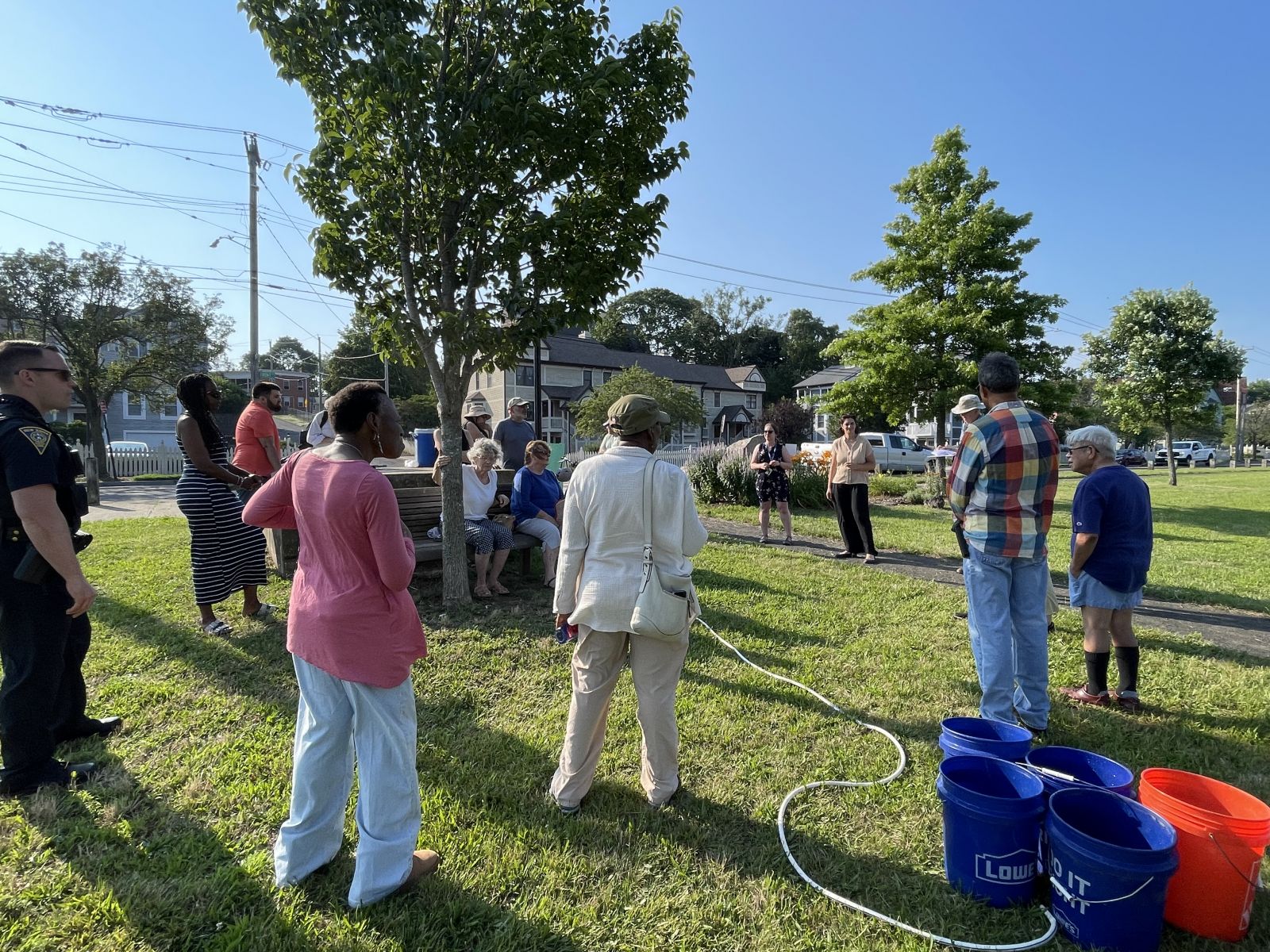
During a July community meeting at the park this past summer, the air was noticeably full of excitement and joy. After a year of surveying, meeting, and planning, a map of the proposed improvements was going to be revealed. The map was drawn up by URI’s Chris Ozyck, who is also a park neighbor. As he walked the group of neighbors and city and state representatives through the plans, clear common themes emerged: the creation of places for people to come together, infrastructure improvement, and ecological restoration.
To generate more opportunities for neighbors to meet, there will be a gathering space with wooden picnic tables near the Grand Ave bridge, game tables farther down the length of the park, and the open field will be maintained. Increasing the tree cover at the park is a big priority, and, where the trail cuts through the path perpendicular to the river, more trees will be planted on either side to provide more habitat and shade. A living shoreline comprised of native plants will be positioned to combat erosion. Popular fishing spots will feature new interpretive signage about the ecological history of the area as well as additional trash cans. Infrastructure improvements include completing the path that makes an incomplete loop around the park and adding three new water spigots, as easy water access will encourage the planting of more trees and perennials.
The next steps in implementing these plans are dependent on final securement of funding so the process can begin. Katherine Jacobs, the Chief Landscape Architect for the City of New Haven, says that once the city approves the grant from the state, they’re hoping to begin the renovations as soon as possible.
Restoring and improving Quinnipiac River Park have been a collaborative effort involving countless people who care deeply for the Fair Haven and New Haven communities. Tom Burwell described the process to me as being similar to making a snowman—“People are holding onto an idea, and they just want to join something they can believe in.” With enough support to get the ball rolling, the momentum and progress build and continue on. Tom’s vision for the park is clear. He wants it to be “a sanctuary, and a tranquil getaway to come into contact with nature,” declaring, “We should all be out there enjoying that peaceful, beautiful waterfront park in New Haven.” The new improvements coming to Quinnipiac River Park will go a long way toward making that dream a reality.